On the Mass Cultural Council’s podcast, Creative Minds Out Loud, we spoke with Artistic Director Julie Boyd.
Through Barrington Stage Company’s creative youth development program, Playwright Mentoring Project, theatre is used as a catalyst to help under-served youth learn skills to aid them in developing positive self-images. Boyd speaks to the cathartic nature of this work and to how their programs in education and theatre-making interweave.
Name: Julie Lichtenberg Organization:The Performance Project Title: Artistic Director Artistic Genre: Theater Years in the Field: 35
What do you do at The Performance Project?
With First Generation: I teach physical theater and work with groups of young adults to form an ensemble and create devised theater. Then we perform the pieces that we’ve created on college campuses, in theaters and other places. I also bring artists in to train with the ensemble and help develop the performances. I schedule performances, fundraise, coordinate, work with interns, plan meals, plan sleepovers and retreats, transport, plan and host family events in collaboration with First Gen youth, go on field trips, celebrate birthdays and graduations. I also teach and/or coordinate our Visual Arts programing.
Why do you do what you do?
Because I am always learning and being inspired by the First Generation community. We managed to create a little place that is caring, nurturing, creative, and fun, and we all dream big together.
What comes easiest to you in this work?
Sitting in the First Gen circle, talking and laughing is what comes easiest to me. I have never thought of this as “work.” This is what I’ve always been driven to do as person and as an artist, and it’s taken different forms throughout the years. So I would say, I’m breathing, not working. But it’s not easy, because of what we have to do to keep it going.
What challenges you in this work?
Over the years, a big challenge has been, having to explain the many layers of our artistic community to someone who might only understand things in terms of distinct and separate categories. That’s why I’ve been so grateful that there is finally the term, ”creative youth development,” which encompasses so much of what we do. Not all, but much of it. Also a big challenge is that sadly, we recently lost our home-base in Springfield, and that has been really difficult.
What does it mean to your community that you do this work?
More than one community engages with The Performance Project. Here’s some examples: First Gen youth have described First Gen as a safe space, fun, and second family. That First Gen supports them pursue their dreams. Their families say First Gen is a big support. People who come to our performances say they are moved and inspired, and often provoked to think about things. We have college interns who give a lot and learn a lot with us.
How do you blow off steam?
Watch movies. Workout. Laugh. Cry.
What do you create in your free time?
I write
Whose work in the creative youth development field do you admire and why? Everett Company because they seem to be a truly inter-generational arts community. I admire their artistic work and their as their commitment to truth-telling and liberation.
The National Arts and Humanities Youth Program Award, given by the President’s Committee on the Arts and the Humanities, is the nation’s highest honor for out-of-school arts and humanities programs that celebrate the creativity of America’s young people, particularly those from underserved communities. This award recognizes and supports excellence in programs that open new pathways to learning, self-discovery, and achievement. Each year, the National Arts and Humanities Youth Program Awards recognize 12 outstanding programs in the United States, from a wide range of urban and rural settings.
How can creative change makers walk their talk and more effectively enact the change they want to see in the world? What do innovation and adaptive change look like for organizations that have social change as their core mission? A collection of profiles released this month as part of EmcArts’ Innovation Labs explores these questions in their publication, “Innovation in Action: Three Case Studies from the Intersections of Arts and Social Justice.”
Featuring Massachusetts’ own The Theater Offensive, as well as Alternate ROOTS, and Jane Addams Hull-House Museum, this publication examines the contours, possibilities and limitations of innovation and adaptive change at the intersection of arts and social justice.
The Theater Offensive entered the Innovation Lab to design a national organizing model to support and encourage Lesbian, Gay, Bisexual and Transgender (LGBT) youth theaters nationally through
the Pride Youth Theater Alliance (PYTA). PYTA’s mission is to “connect and support queer youth theater organizations, programs, and professionals committed to empowering lesbian, gay, bisexual, transgender, queer and allied (LGBTQA) youth in North America.” Through the Innovation Lab process, the The Theater Offensive team explored these questions:
How can youth leadership be operationally central to PYTA, and
How can the national PYTA network take advantage of the capacities of the locally grounded organization (The Theater Offensive)?
Through their Youth Arts Action Initiative, MASSCreative partners with 18 youth arts groups to provide advocacy training and opportunities for participants to effect change in their communities. Their youth partners represent a broad spectrum of disciplines – from music, theatre, dance, and visual art – and come from diverse backgrounds representing communities around Greater Boston and beyond.
Young artists are already drawn to advocacy. All they need are the right tools to make the political case that arts matter. At MASSCreative, we’ve seen this advocacy firsthand.
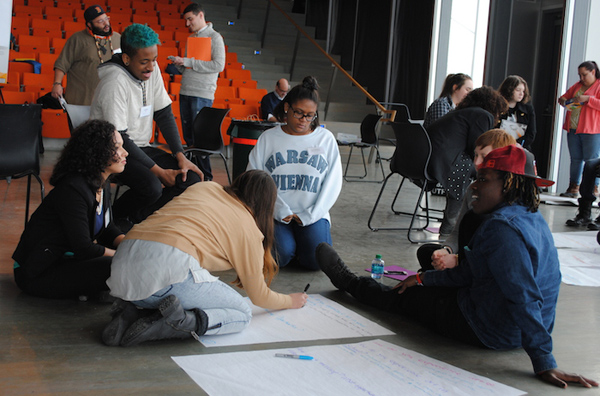
In the last few months, the Youth Arts Action Coalition has convened three times, and began to steadily build an advocacy movement in Massachusetts fueled by young artists. In February, our partners came together at the Institute of Contemporary Art in Boston for a day of training and collaboration that would spark future advocacy. To kick off the day, Sara Stackhouse of Actors’ Shakespeare Project led an exercise that showed us how to tell our stories through the political organizing lens of the Marshall Ganz model. In this exercise, participants took time to understand their own role in the arts and cultural community by learning to tell three stories: ‘of self,’ ‘of us,’ and ‘of now’. Through this model, youth got the chance to tell their own story, connect to the values and interests of their peers, and inspire urgency in what we must do to make change happen.
This exercise revealed to us that tomorrow’s advocacy leaders were right there in the room. For our young artists who are so deeply involved in their own communities, envisioning themselves as part of an advocacy movement was the next logical step.
Next up, it was time to make waves at the State House. Our Youth Arts Action partners – now well-equipped to make their case – joined MASSCreative and 250 other arts advocates at #ArtsMatter Advocacy Day on March 25.
Among the crowd, young people stood out. They marched with pride and conviction in our #ArtsMatter march, turning heads and rallying the troops to make a difference at the State House. When we met with our legislators to talk about arts and cultural impact, it was their stories that helped drive home the message that arts aren’t just nice, but necessary. Their active participation in legislative meetings all over the State House was proof enough of this impact.
Later on, our youth partners took their advocacy a step further by doing what they do best: sharing their art. Youth leader Nick from Zumix took the mic and shared a rap about the impact of arts and culture in their own lives.
With heads nodding along in the audience, Nick made his point clear. The arts matter. They matter in our classrooms, in our neighborhoods, in all spaces occupied by youth. And with a few bars, Nick says it all:
“World leaders are not that; Imagination rules.
So stop taking music and art out of our schools.
I don’t want to hear that it’s not important
You should forfeit that argument; we’re not standing dormant.”
Drew Esposito is a Program Associate at MASSCreative. MASSCreative is proud to collaborate with 18 Youth Arts Action partners: Actors’ Shakespeare Project, Artists for Humanity, Boston Arts Academy, Boston Children’s Chorus, Boston Youth Symphony Orchestra, Hyde Square Task Force, Inquilinos Boricuas en Acción, Institute of Contemporary Art, Massachusetts Cultural Council, The Mayor’s Youth Council of Boston, Raw Art Works, Sociedad Latina, Teen Empowerment, The Theater Offensive, The Urbano Project, Urbanity Dance, Walnut Hill School for the Arts, and ZUMIX.
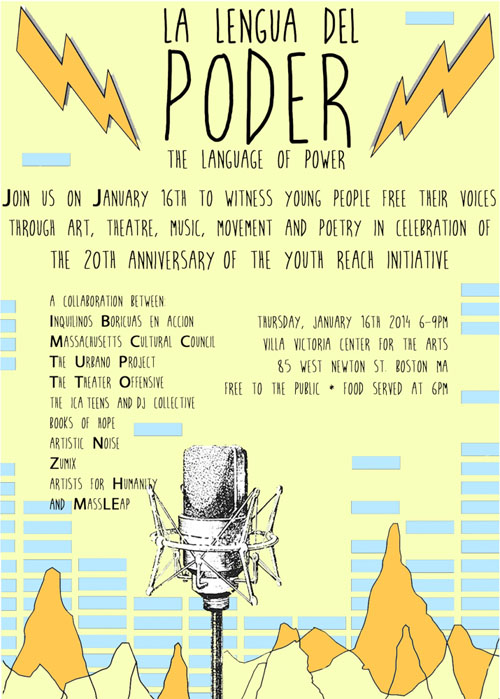
Charge up for the new year. On January 16, 2014 Inquilinos Boricuas en Accion hosts La Lengua del Poder (The Language of Power), a showcase of young people freeing their voices through visual art, theater, music, movement, and poetry. Free. 6-9pm. Villa Victoria Center for the Arts, 85 West Newton St., Boston. Part of the YouthReach 20th anniversary celebration.
Pittsfield’s Juvenile Resource Center (JRC), a collaboration between the Berkshire County Sheriff’s Office and the Pittsfield Public Schools, provides education, casework, counseling, and employment services to young people at high risk of dropping out of school. With the help of YouthReach funding, Berkshire Theatre Group (BTG) launched a partnership in 2012 with the JRC, using theatre tools to build confidence and communication skills while placing the young people in jobs throughout Pittsfield’s Colonial Theatre. Kate McGuire, Artistic Director and CEO of Berkshire Theatre Group, reflects on the partnership’s first year:
In the theatre, we learn to listen. For me, I was able to hear and understand the nature of these kids’ lives and learn about the challenges they face minute to minute.
At the beginning, there was so much noise. They were loud, and so aggressive towards each other in their language and sometimes, physically. By the end of the semester, we all learned to attend to each other, to listen more carefully. Order and calm and a real sense of joy set in.
The first week of the program, we went to see a movie. It was a disaster. I was amazed they didn’t get thrown out as they could not keep quiet, keep still, or keep their hands off each other.
Over the course of six months, we used actor-training exercises to encourage each young person to find new tools of expression and at the same time, sharpen our awareness of ourselves as part of an ensemble, a community. Meanwhile, BTG staff worked with each participant’s interests and ambitions to build custom internship experiences for each.
In the final week of this first year, we all went out to dinner. The youth were polite, well spoken, and we might as well have been celebrating Christmas. There was such a warmth and genuine care among us all.
We had accomplished something remarkable, and we were all aware that each one of us had changed, grown, and learned to care about each other and each others’ lives in profound ways.
The Colonial Theatre must be comfortable for everyone to walk through. We have succeeded with these young people. By the end, the kids were not a part of the BTG. They were integrated into the entire organization. Three of them continued through the summer: one in the box office, one onstage for Peter Pan, and one providing technical support. JRC staff noted the value in the relationship, and the region’s Sheriff lauded our work to one of our trustees.
Years ago I entered the theatre with the belief that we could transform lives profoundly. This work is serving that belief. What I did not know was how deeply I could still be impacted by the power of the theatre to help and change lives. I am grateful to the young people I have worked with through the JRC, and I can’t wait to meet a new class later this fall!
Kate McGuire
Artistic Director and CEO
Berkshire Theatre Group

 On the Mass Cultural Council’s podcast, Creative Minds Out Loud, we spoke with Artistic Director Julie Boyd.
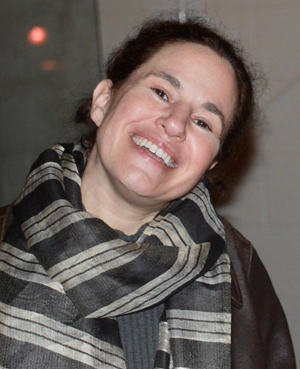 Name: Julie Lichtenberg